Monday, December 31, 2007
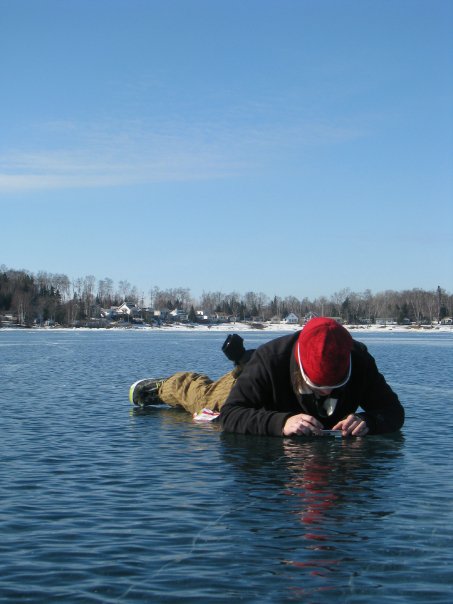
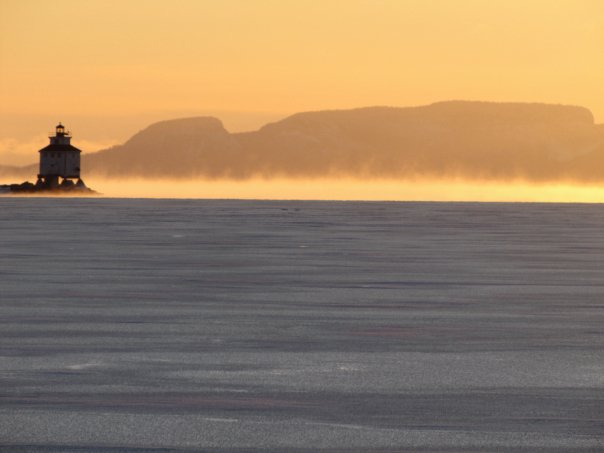
Photo Submissions
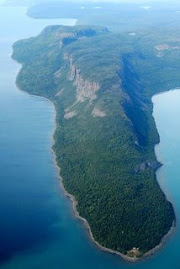
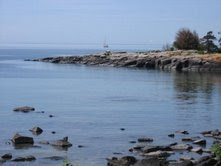
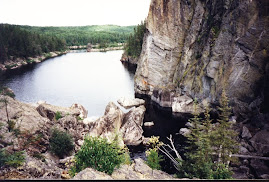
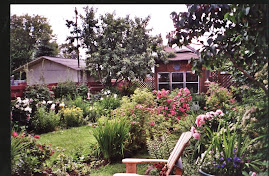
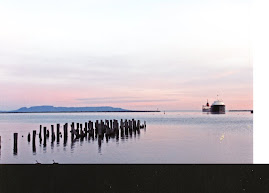
If you would like to see your photo on Literary Thunder Bay, please send as a jpeg attachment to joanbaril@gmail.com. We are looking for photos relating to Thunder Bay, Lake Superior or north-western Ontario. Photos of the old days are also welcome. A photo must be your original work. Please add title of the photo, your full name and any other information you want printed with the photos.


Saturday, December 29, 2007
Alone, a short story by Nancy Bjorgo
He was tired of it. Henry Sousa was tired of being alone.
It was 9 a.m., Monday, his day off. At Safeway, he walked past a man in a check-out line who cradled a big bunch of celery against his chest like a baby. The man’s left elbow was raised to protectively support its little leafy top. When Henry got to the cookie aisle, the loud-speaker system said, "Hello, honey." He waited, expecting an announcement for honey on sale. But there wasn’t one. Hello, honey. He imagined two employees manning (or manning and womanning) a microphone in a small, steamy booth. He searched his inner mind. Auditory hallucinations? God?
He grabbed two packages of Christie’s Pecan Passion cookies. He liked how the cookies crumbled around the pecan bits when he took a bite.
Henry was, you know, not that bad looking, a bit pear-shaped from behind, it was true. Not Bartletts which were very thin in the shoulders but more like sweet green Anjous. Portly, if he were older. Which he wasn’t. So that was a good point. He was still in the running.
Most days off, he wore grey slacks, a white shirt, a grey three-season overcoat. He wore such clothing to work, too, and then changed into his pharmaceutical coat. He had a healthy comb-over. He was a pharmacist at a south-ward Safeway, but he liked shopping in the north.
He generalized. Short, black-haired women seemed to like him. They came up to the middle of his chest where their vigorous hair bounced and their foreheads were spacious, probably because of the angle of foreshortening at which he saw them. Dates? Yes, lots of them. And then when he got around to explaining that Daniel, his older brother, was in a mental institution, their hair stopped bouncing and they ate their dinners or danced the dance silently.
Daniel had visual hallucinations. Henry made him give up driving when Daniel told him that every light looked green to him, even the red. And Daniel was spurred into action by green. He sped up, he careened away, and then it didn’t take that long until other difficulties arose.
On one crucial date, Henry actually took Daniel along to a restaurant. He had to have what remained of his family out in the open. He and Daniel, for better or worse (worse), looked alike except Daniel had good hair.
"That’s the exit," he explained to Daniel, pointing to a plump red exit light (green for Daniel) over a back door. "Don’t go out there, right? We have lots of time. Lots of time for a meal." Henry held Caroline’s chair for her and they all sat at a table not in view of the exit light.
Henry knew he had to watch Daniel carefully. He had to anticipate Daniel bunching his muscles and springing for the exit.
They were all, of course, a bit tense. Caroline said, her eyes faltering slightly, "It’s a lovely restaurant." But her smile didn’t waver.
Daniel said, "Henry likes to eat here. It’s one of his favourite places."
Henry was hopeful until Daniel started eating the salad with his fingers. It had happened before. When he was over-dosed on medication, he could converse, but he couldn’t manipulate silverware.
Caroline’s face didn’t crumple, exactly, but any trace of a smile vanished. He emphathized with her.
Henry liked women. He had liked his small, thin mother even in her dotage. She had painted a big white cloud on her kitchen floor and put a "9" on it. So she could be on Cloud 9 whenever she wanted to be, she said, whenever she didn’t want to think about Daniel. And then in the hospital, she murmured, "Put your head upon a pillow, ‘neath a weeping willow and watch the clouds roll by. You’ll find your love in the sky. Just watch the clouds roll by."
He didn’t realize that she was probably making a joke until she breathed, "If your heart for love is aching and it’s almost breaking, just watch the clouds roll by. You’ll find your love by and by. Just watch the clouds roll by." Those were her last words. Really a lot of words. Summoned up for him, he felt, but he wasn’t absolutely sure. They were raspy and carefully phrased, breathy, lingering, like a good jazz clarinetist might have done. Did that mean jazz was close to life and death? Encompassing? Or closer to death?
Though he had never heard the words before, he remembered them. It was several days—or weeks—until it occurred to him that there had been a reedy tune, as well.
He moved out of his apartment into her house, into his birthplace house—with Cloud 9—on Broadway Avenue, past old historical Fort William, but not where backyard basements were crumbling into the Kaministiquia River. He got there from the south end by driving past the airport and turning right at the graveyard which spread on either side of the country street.
The house had a low cottagey front porch; the back of the house emerged one and a half storeys because of the down-sloping yard. It was painted old-fashioned light green. Henry liked to sit behind the house in an old wicker chair that had a high back and low rounded arms. From there, the river was light blue at a distance. He always remembered to bring the green and white striped seat cushion back into the house in case of rain.
Waiting for a woman who might look and smile favourably at him again like Caroline, Henry tried to keep fit. He put more commonly called-for drugs on top shelves so he would have to stretch for them. Fellow workers complained but he persevered. He could do—and once in a while did—a mean cartwheel in the lead-up space to his pharmacy counter after he had shown a woman where the Q-tips were or the Band-Aids. He had mastered cartwheels in grade three. His shape hadn’t changed that much since then, just his size. He had pleased Miss Hargreave with his cart-wheels long ago. Now, he would cart-wheel and end up with his hand nonchalantly on the counter and say, "What’s up, doc?" to Mary who worked days with him and kept her three children and husband in line on her off hours.
Henry’s father, a high school English teacher, had wanted him to study literature, complimenting him that he had the mind for it. But Henry wanted something more exact and was approaching his last year of pharmaceutical studies. It was summer—August—when Henry’s father died unexpectedly of a heart attack.
It had been a hot day. Henry was trenching-in unsold three-year-old roses at Hyatt’s Greenhouses to winter them over. How they were going to stay alive in that dry, sandy field was anybody’s guess. They had only their restricted, potted roots, nothing more. He set his spade upright in the ground when Old Man Hyatt came across the field from the house and told him his mother had phoned, saying that the ambulance had already taken off down the road.
The Sousas were dwindling fast. Henry’s father had been an only child.
Henry sometimes saw a family on Saturdays, his other day off, at this north-end Safeway, the father in tweeds, dark-haired mother, three little daughters and probably a tiny son in a heavy-duty carriage with what seemed like off-roader wheels. He could be that man. Except for the English accent. Lose the English accent.
Bread and butter, bacon and eggs in his cart, Henry hit the fruit section last. A tall blonde woman whose long straight hair spread like a light around her shoulders hefted orange after orange in her right hand, trying to pick the heavy, juicy ones. Women weighed fruit like that. Men went for appearances.
When he was sure she was looking at him, Henry did his neatest nip and tuck cartwheel for the woman at the mound of oranges, the hem of his overcoat hardly flapping. "Hello, honey," he said, forgetting that he wanted to hear it, not say it. She giggled at him and threw him the orange which she had been hefting. He caught it smartly.
Then she turned away, her eyes still crinkling in a smile. He smiled back at her, at her back, unfortunately. Too late.
He wanted to lose his identity or gain it. He wasn’t sure that they weren’t the same thing. If he had children, his family name would not disappear. If he had children, he would at least disappear into his children’s memories for awhile. Lose with dignity. Amplify, maybe. Be more than he was. A man who exists in someone’s memory. He couldn’t count on Daniel.
The 9-items-or-less-Scandinavian-goddess-woman at the check-out called, "Hurry up, men. Flex it fast. Air Miles?" Old, young, toothless, and toothy men gathered in her line, under her power. He counted his cookies, eggs, butter, marmalade, and limp lumpy bags of fruit. Yes, he qualified, too.
He signed a cheque and quickly slung the two plastic bags of groceries over his left wrist. His car was parked practically at the door. He settled the bags in the seat beside him and was about to turn the key.
Just over the driveway in front of the Safeway doors stood the Scandinavian goddess and the woman with flashlight hair. They were both tall. Radiant in the morning sunshine. Smiling like crazy.
The goddess waved a piece of paper. The other blonde waved both her hands over her shopping cart. At him. He got out and the piece of paper was thrust in his hands. He had signed his name Henry Safeway. He had to think fast.
Somehow he had to turn this to his advantage. He had to turn everything to his advantage now.
It was 9 a.m., Monday, his day off. At Safeway, he walked past a man in a check-out line who cradled a big bunch of celery against his chest like a baby. The man’s left elbow was raised to protectively support its little leafy top. When Henry got to the cookie aisle, the loud-speaker system said, "Hello, honey." He waited, expecting an announcement for honey on sale. But there wasn’t one. Hello, honey. He imagined two employees manning (or manning and womanning) a microphone in a small, steamy booth. He searched his inner mind. Auditory hallucinations? God?
He grabbed two packages of Christie’s Pecan Passion cookies. He liked how the cookies crumbled around the pecan bits when he took a bite.
Henry was, you know, not that bad looking, a bit pear-shaped from behind, it was true. Not Bartletts which were very thin in the shoulders but more like sweet green Anjous. Portly, if he were older. Which he wasn’t. So that was a good point. He was still in the running.
Most days off, he wore grey slacks, a white shirt, a grey three-season overcoat. He wore such clothing to work, too, and then changed into his pharmaceutical coat. He had a healthy comb-over. He was a pharmacist at a south-ward Safeway, but he liked shopping in the north.
He generalized. Short, black-haired women seemed to like him. They came up to the middle of his chest where their vigorous hair bounced and their foreheads were spacious, probably because of the angle of foreshortening at which he saw them. Dates? Yes, lots of them. And then when he got around to explaining that Daniel, his older brother, was in a mental institution, their hair stopped bouncing and they ate their dinners or danced the dance silently.
Daniel had visual hallucinations. Henry made him give up driving when Daniel told him that every light looked green to him, even the red. And Daniel was spurred into action by green. He sped up, he careened away, and then it didn’t take that long until other difficulties arose.
On one crucial date, Henry actually took Daniel along to a restaurant. He had to have what remained of his family out in the open. He and Daniel, for better or worse (worse), looked alike except Daniel had good hair.
"That’s the exit," he explained to Daniel, pointing to a plump red exit light (green for Daniel) over a back door. "Don’t go out there, right? We have lots of time. Lots of time for a meal." Henry held Caroline’s chair for her and they all sat at a table not in view of the exit light.
Henry knew he had to watch Daniel carefully. He had to anticipate Daniel bunching his muscles and springing for the exit.
They were all, of course, a bit tense. Caroline said, her eyes faltering slightly, "It’s a lovely restaurant." But her smile didn’t waver.
Daniel said, "Henry likes to eat here. It’s one of his favourite places."
Henry was hopeful until Daniel started eating the salad with his fingers. It had happened before. When he was over-dosed on medication, he could converse, but he couldn’t manipulate silverware.
Caroline’s face didn’t crumple, exactly, but any trace of a smile vanished. He emphathized with her.
Henry liked women. He had liked his small, thin mother even in her dotage. She had painted a big white cloud on her kitchen floor and put a "9" on it. So she could be on Cloud 9 whenever she wanted to be, she said, whenever she didn’t want to think about Daniel. And then in the hospital, she murmured, "Put your head upon a pillow, ‘neath a weeping willow and watch the clouds roll by. You’ll find your love in the sky. Just watch the clouds roll by."
He didn’t realize that she was probably making a joke until she breathed, "If your heart for love is aching and it’s almost breaking, just watch the clouds roll by. You’ll find your love by and by. Just watch the clouds roll by." Those were her last words. Really a lot of words. Summoned up for him, he felt, but he wasn’t absolutely sure. They were raspy and carefully phrased, breathy, lingering, like a good jazz clarinetist might have done. Did that mean jazz was close to life and death? Encompassing? Or closer to death?
Though he had never heard the words before, he remembered them. It was several days—or weeks—until it occurred to him that there had been a reedy tune, as well.
He moved out of his apartment into her house, into his birthplace house—with Cloud 9—on Broadway Avenue, past old historical Fort William, but not where backyard basements were crumbling into the Kaministiquia River. He got there from the south end by driving past the airport and turning right at the graveyard which spread on either side of the country street.
The house had a low cottagey front porch; the back of the house emerged one and a half storeys because of the down-sloping yard. It was painted old-fashioned light green. Henry liked to sit behind the house in an old wicker chair that had a high back and low rounded arms. From there, the river was light blue at a distance. He always remembered to bring the green and white striped seat cushion back into the house in case of rain.
Waiting for a woman who might look and smile favourably at him again like Caroline, Henry tried to keep fit. He put more commonly called-for drugs on top shelves so he would have to stretch for them. Fellow workers complained but he persevered. He could do—and once in a while did—a mean cartwheel in the lead-up space to his pharmacy counter after he had shown a woman where the Q-tips were or the Band-Aids. He had mastered cartwheels in grade three. His shape hadn’t changed that much since then, just his size. He had pleased Miss Hargreave with his cart-wheels long ago. Now, he would cart-wheel and end up with his hand nonchalantly on the counter and say, "What’s up, doc?" to Mary who worked days with him and kept her three children and husband in line on her off hours.
Henry’s father, a high school English teacher, had wanted him to study literature, complimenting him that he had the mind for it. But Henry wanted something more exact and was approaching his last year of pharmaceutical studies. It was summer—August—when Henry’s father died unexpectedly of a heart attack.
It had been a hot day. Henry was trenching-in unsold three-year-old roses at Hyatt’s Greenhouses to winter them over. How they were going to stay alive in that dry, sandy field was anybody’s guess. They had only their restricted, potted roots, nothing more. He set his spade upright in the ground when Old Man Hyatt came across the field from the house and told him his mother had phoned, saying that the ambulance had already taken off down the road.
The Sousas were dwindling fast. Henry’s father had been an only child.
Henry sometimes saw a family on Saturdays, his other day off, at this north-end Safeway, the father in tweeds, dark-haired mother, three little daughters and probably a tiny son in a heavy-duty carriage with what seemed like off-roader wheels. He could be that man. Except for the English accent. Lose the English accent.
Bread and butter, bacon and eggs in his cart, Henry hit the fruit section last. A tall blonde woman whose long straight hair spread like a light around her shoulders hefted orange after orange in her right hand, trying to pick the heavy, juicy ones. Women weighed fruit like that. Men went for appearances.
When he was sure she was looking at him, Henry did his neatest nip and tuck cartwheel for the woman at the mound of oranges, the hem of his overcoat hardly flapping. "Hello, honey," he said, forgetting that he wanted to hear it, not say it. She giggled at him and threw him the orange which she had been hefting. He caught it smartly.
Then she turned away, her eyes still crinkling in a smile. He smiled back at her, at her back, unfortunately. Too late.
He wanted to lose his identity or gain it. He wasn’t sure that they weren’t the same thing. If he had children, his family name would not disappear. If he had children, he would at least disappear into his children’s memories for awhile. Lose with dignity. Amplify, maybe. Be more than he was. A man who exists in someone’s memory. He couldn’t count on Daniel.
The 9-items-or-less-Scandinavian-goddess-woman at the check-out called, "Hurry up, men. Flex it fast. Air Miles?" Old, young, toothless, and toothy men gathered in her line, under her power. He counted his cookies, eggs, butter, marmalade, and limp lumpy bags of fruit. Yes, he qualified, too.
He signed a cheque and quickly slung the two plastic bags of groceries over his left wrist. His car was parked practically at the door. He settled the bags in the seat beside him and was about to turn the key.
Just over the driveway in front of the Safeway doors stood the Scandinavian goddess and the woman with flashlight hair. They were both tall. Radiant in the morning sunshine. Smiling like crazy.
The goddess waved a piece of paper. The other blonde waved both her hands over her shopping cart. At him. He got out and the piece of paper was thrust in his hands. He had signed his name Henry Safeway. He had to think fast.
Somehow he had to turn this to his advantage. He had to turn everything to his advantage now.
Saturday, December 22, 2007
A Christmas Poem by Margaret Rose Cunningham
ONE DULL DAY
One red rose
Frozen in the garden
One red leaf
Shivering on a branch
One red bird
Carolling on high.
Enough to cheer.
Enough to brighten.
Enough to signal hope.
by Margaret Rose Cunningham
One red rose
Frozen in the garden
One red leaf
Shivering on a branch
One red bird
Carolling on high.
Enough to cheer.
Enough to brighten.
Enough to signal hope.
by Margaret Rose Cunningham
Friday, December 21, 2007
Winner of Contest for Late Nights on Air by Elizabth Hay
WINNER ANNOUNCED. The winner of the draw for the Giller Prize winning novel. Late Nights on Air by Elizabeth Hay is Peggy Lauzon. Congratulations Peggy! The winning name was drawn on December 20 by Danelle Muckle of the Kaministiquia writing group.
In order to enter the draw, you had to name a favourite Canadian work of fiction. Some of the picks were: A Fine Balance by Rohinton Mistry (entered by Sarah Eckler), Lullabies for Little Criminals (entered Gwen O’Reilly, Betsy Martin and others), The Frozen Thames by Helen Humphries(Chris MacDonald), A Student of Weather by Elizabeth Hay (Jacqueline D’Acre), Three Day Road by Joseph Boydon (Ted Fryia), Almost Japanese by Sarah Sheard (Peggy Lauzon), How I Spent my Summer Holidays by W.O. Mitchell, (Erin Stewart), Tamarind Men by Anita Rau Badami (Northshorewoman).
Other Canadian favourites were The Jade Peony by Wayson Choy, The Other Side of the Bridge by Mary Lawson, The Stone Angel by Margaret Lawrence, Honour the Sun by Ruby Slipperjack, Oryx and Crake by Margaret Atwood, The English Patient by Michael Ondaaje, Life of Pi by Yann Martel, Tuppenence to Cross the Mersey by ?, The Josephine B. series by Sandra Gulland, The Village of Small Houses by Ian Ferguson, Tin Flute by Gabrielle Roy, Dead Dog Café by Thomas King, anything by Alice Munro, anything by Seymour Blicker, Stone Diaries by Carol Shields (2 votes), Who Has Seen the Wind by W.O. Mitchell, and, of course, Anne of Green Gables by L.M. Montgomery.
Thanks to all who entered. Stay tuned for the next draw after Christmas.
In order to enter the draw, you had to name a favourite Canadian work of fiction. Some of the picks were: A Fine Balance by Rohinton Mistry (entered by Sarah Eckler), Lullabies for Little Criminals (entered Gwen O’Reilly, Betsy Martin and others), The Frozen Thames by Helen Humphries(Chris MacDonald), A Student of Weather by Elizabeth Hay (Jacqueline D’Acre), Three Day Road by Joseph Boydon (Ted Fryia), Almost Japanese by Sarah Sheard (Peggy Lauzon), How I Spent my Summer Holidays by W.O. Mitchell, (Erin Stewart), Tamarind Men by Anita Rau Badami (Northshorewoman).
Other Canadian favourites were The Jade Peony by Wayson Choy, The Other Side of the Bridge by Mary Lawson, The Stone Angel by Margaret Lawrence, Honour the Sun by Ruby Slipperjack, Oryx and Crake by Margaret Atwood, The English Patient by Michael Ondaaje, Life of Pi by Yann Martel, Tuppenence to Cross the Mersey by ?, The Josephine B. series by Sandra Gulland, The Village of Small Houses by Ian Ferguson, Tin Flute by Gabrielle Roy, Dead Dog Café by Thomas King, anything by Alice Munro, anything by Seymour Blicker, Stone Diaries by Carol Shields (2 votes), Who Has Seen the Wind by W.O. Mitchell, and, of course, Anne of Green Gables by L.M. Montgomery.
Thanks to all who entered. Stay tuned for the next draw after Christmas.
Sunday, December 16, 2007
THE SNAIL HOUSE by Joan Baril
A northern Ontario true story which goes a long way to explain why we love winter.
It all started innocently enough with a golden dawn that filled the tent with light. However, I could hear a rambunctious wind romping through the pines above dropping numerous needles and twigs on the nylon fly which was puffing in and out like a bellows. I huffled my body a few inches out of the sleeping bag to look through the tent’s back window. On the far side of the sand beach a few yards away, the silky water of the bay was barely wrinkled but on lifting my head, I could see beyond the sand spit to the open reaches of the lake. There, in contrast, the wind was bullying along a platoon of white caps in a frenzy of foam as if it wanted to empty the lake of water. I sighed. This could only mean our plan to find the Snail House would have to be put on hold, at least for today. We were wind bound.
But something closer at hand caught my eye. The guy ropes holding the fly were dotted with glossy black chunks like tar. I wondered if sap had dripped from the pine trees. I’d never heard of such a thing, but I knew the bush was full of surprises.
The day before had been a camper’s dream. After the float plane had dropped the three of us at this perfect site and we set had up our tents and stowed our gear, we fired up the stove and toasted ourselves with our first cup of tea. Then bathing suits, a swim in crystalline water and into the canoe to get dinner. In half an hour, my sister Barbara got three pickerel. While her husband Terry filleted the fish, Barb and I made a fire and set out a good northern meal– fried pickerel, coleslaw, perogies with Thunder Bay persian donuts for dessert. We finished the evening off with another swim and more tea, this time laced with rum. A golden eagle flew by. As the July sun slowly departed in an extravaganza of colour, behind us over the pines, a yellow moon sidled in.
Before us, in the moonlight, was a long reach of lake. We could see the lights of a small cabin far down the shore. On the other side of the sand spit was the channel between the island and the mainland. This channel was our route to the Beckwith place and the Snail House. We were looking forward to the morrow.
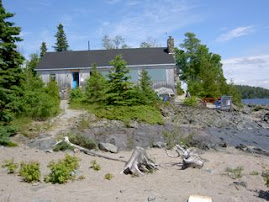
Wendell Beckwith, the famous American hermit, had lived for eleven years at Whitewater Lake about three miles from our camp site. In 1980, he’d been found dead on the beach in front of his most famous dwelling, the mysterious spiral shaped Snail House. Beckwith claimed the Snail House had a mystical influence on his research into the forces of gravity. We’d learned the buildings were still standing and open to the public. I was interested to see if any emanations remained.
But now, on this windy morning, I climbed out of the tent, into a maelstrom—a storm of mosquitoes. The black chunks on the guy ropes were not sap; they were clusters of mosquitoes as big as grapes. The outside of the tent had a black pelt created not be pine needles but by thousands of mosquitoes and, in a single second, so had I. I dived back in, found my mesh bug jacket, and jumped out to see my sister running for the beach.
Her tan-coloured canoe pants and shirt were alive with crawling black dots. The song of the wind in the pines, so soothing in the early morning, was also, I now realized, the feeding song of billions of mosquitoes. We three had spent our lives in the northern Ontario bush and we were used to bugs – even lots of bugs - but we had never experienced anything like this.
“We have to get out of here,” my sister cried..
But we could see that was impossible. The wind, coming over the trees behind us, was frothing up the lake and the water in the channel between the island and the mainland was roaring past like a deranged river.
The mosquitoes seemed sparser on the beach, so we decided to move the tents there. We raced around in a bug-induced frenzy, tossing out gear, yanking up stakes, running off with the tents, and running back for our stuff to shove inside.
“I have to go to the bathroom,” I said to my sister. “How am I going to do that?” We both glared at Terry who was stepping from behind a screen of bushes zipping up his fly. “There is one disadvantage to being female,” I said.
“Don’t look at me,” he said. “I had to fan the area with a piece of birch bark just to keep myself intact.”
We quickly dug out an old polyester shower curtain we used as a picnic blanket and I ran off into the woods. Never was anything done so quickly or so badly. My plan was to tie the curtain around my waist as a sort of skirt. This did not work. A thousand mosquitoes settled on my bare thighs. I flapped my hands but this only encouraged them. Meanwhile the wind blew the curtain under me…
Terry and Barb had set up our trusty alcohol stove on the very end of the sand spit. The sand was wet out there and soft but a bit of a breeze was reaching the tip of the spit keeping the bugs away. Two steps toward shore and the breeze was blocked by the tall pines. Another step and you hit the Great Wall of Mosquito. With our feet sinking into the mushy sand, we ate a gloomy breakfast standing up at the end of a sand spit twenty feet out in the lake.
At that moment, it began to rain. We dived for the tents and our rain gear but, when we came out, we learned the Whitewater Lake mosquitoes sneer at rain. Their numbers diminished not at all.
The night before, we’d set up a tarp under the pines in case of rain. The mosquitoes liked it under there. It was mosquito city. Walking under the tarp was like walking into a cloud of soot from a defective chimney. We realized it was better to take down the tarp, stow it away and go back to the end of the sand spit, stand there, sinking into the ground and wait for the rain to blow over. Which it did in a few minutes.
Every trip away the spit to the beach was fraught. We need matches? Barb made the dash, yelling,”Where the hell are they?” Tea bags? My fingers opening the buckles of the pack were being dive bombed. “I don’t see no tea bags.” Grammar disappears at a time like this. Terry ran by. “The water jug? Where’s the god damn water jug?” We had covered ourselves with bug spray, but the black clouds circling around our heads and the thousands of crawling specks covering our bodies were creating a severe psychological challenge.
“I think I have to go to the bathroom again,” I said. “Give me the bug spray. I may end up with some terrible rash, but I don’t care.”
In front of us, the small bay was fairly calm even though the lake beyond was jumping in foam. We decided to canoe along the bay to see if we could get around the far side of the island. It was a good decision. There were fewer mosquitoes out on the water so we loafed and caught a couple of pickerel. But we also realized that it was impossible to move from our sheltered bay. I was thinking we should get our books and spend the morning drifting and reading when it started to pour again. We headed back to the tents.
Barb made the lunch sandwiches in her tent. When the shower passed, we ate sinking in the sand spit and leaning as far out as possible to get the bit of breeze coming over the tall trees. From time to time the wind dropped, and then we were immediately invaded.
The channel seemed a little less rough in the afternoon, so we launched the canoe and began tacking up the current in a series of forward ferries, a white water maneuver. But after a mile, we knew we were exhausting our strength, and, eventually, we also realized we would never be able to navigate the heavy seas at the far end of the island. Meanwhile, a series of showers swept through, but, after each, the sun came out.
We sailed back to camp with the wind, retreating to our tents to smoke the bugs out with mosquito coil. Once my place was cleared, I slept and read the day away. I was hoping for a better tomorrow. I was also wondering if it was my turn to make supper and how I was going to do it. I made Kraft Dinner while Terry fried the pickerel. We took turns standing in the smoke from the fire. We ate in a tent. Four or five more showers swept through but the wind did not abate and by the next morning we realized we were trapped for another day.
Another decision – to attempt the rough paddle over to the cabin and see if the person there had a radio to send for the plane. We were greeted by a Native family who had been watching us struggle through the waves. They invited us inside. Their log cabin consisted of one large room, all very neat and clean with a set of bunks for the two teen- age boys and, behind a curtain, a bed for the parents, Bill and Jean. The walls held many drawings made by the boys. There were books around as well as cards and board games.
“Too rough to fish, too rough to canoe,” Bill said. “Nothing to do but wait it out.” The tea was brought out and set on the table by the window. “How about some cards” he said. “I know a dynamite game. It’s called Bad Ass Rummy.”
We played the game for most of the afternoon. It turned out Bill could radio to the airline to come and rescue us if we got sick of the weather. We said we’d stick it one more day because we wanted to go up and see the Snail House. “Same weather tomorrow,” said Bill, “but if the wind holds, it’ll be calm enough in your little bay for the plane to get you out.”
We stuck it out another day and then caved. That morning we paddled over and asked Bill to send the message. Later, we stood on the sand spit in the rain, waiting for the plane. We were a disheartened trio.
A couple of years later, I attended a birding festival in North Dakota and found myself telling the story to a mosquito expert. “Interesting experience,” he said. “Here is what happened to you. As you know, mosquitoes lay eggs in shallow water. In hot weather, such as you have in June and July, the water dries up. But the eggs do not die. They remain dormant in the earth until rain fills the puddles. Every time it rained, more puddles filled and more mosquitoes were released from the wet lands behind your camp site. The wind carried them straight toward you.” He smiled.
“I remember one study here in North Dakota,” he went on. “In a two foot study area we had 6 mosquitoes. After a rain, we had ten thousand.” He smiled again. “Big difference.” No kidding.
The Snail House is still out there. Other people have gone to visit it and told us what a wonderful canoe trip they had. But my desire to see it is buried on a long squashy sand spit at the end of an island in Whitewater Lake.
It all started innocently enough with a golden dawn that filled the tent with light. However, I could hear a rambunctious wind romping through the pines above dropping numerous needles and twigs on the nylon fly which was puffing in and out like a bellows. I huffled my body a few inches out of the sleeping bag to look through the tent’s back window. On the far side of the sand beach a few yards away, the silky water of the bay was barely wrinkled but on lifting my head, I could see beyond the sand spit to the open reaches of the lake. There, in contrast, the wind was bullying along a platoon of white caps in a frenzy of foam as if it wanted to empty the lake of water. I sighed. This could only mean our plan to find the Snail House would have to be put on hold, at least for today. We were wind bound.
But something closer at hand caught my eye. The guy ropes holding the fly were dotted with glossy black chunks like tar. I wondered if sap had dripped from the pine trees. I’d never heard of such a thing, but I knew the bush was full of surprises.
The day before had been a camper’s dream. After the float plane had dropped the three of us at this perfect site and we set had up our tents and stowed our gear, we fired up the stove and toasted ourselves with our first cup of tea. Then bathing suits, a swim in crystalline water and into the canoe to get dinner. In half an hour, my sister Barbara got three pickerel. While her husband Terry filleted the fish, Barb and I made a fire and set out a good northern meal– fried pickerel, coleslaw, perogies with Thunder Bay persian donuts for dessert. We finished the evening off with another swim and more tea, this time laced with rum. A golden eagle flew by. As the July sun slowly departed in an extravaganza of colour, behind us over the pines, a yellow moon sidled in.
Before us, in the moonlight, was a long reach of lake. We could see the lights of a small cabin far down the shore. On the other side of the sand spit was the channel between the island and the mainland. This channel was our route to the Beckwith place and the Snail House. We were looking forward to the morrow.
Wendell Beckwith, the famous American hermit, had lived for eleven years at Whitewater Lake about three miles from our camp site. In 1980, he’d been found dead on the beach in front of his most famous dwelling, the mysterious spiral shaped Snail House. Beckwith claimed the Snail House had a mystical influence on his research into the forces of gravity. We’d learned the buildings were still standing and open to the public. I was interested to see if any emanations remained.
But now, on this windy morning, I climbed out of the tent, into a maelstrom—a storm of mosquitoes. The black chunks on the guy ropes were not sap; they were clusters of mosquitoes as big as grapes. The outside of the tent had a black pelt created not be pine needles but by thousands of mosquitoes and, in a single second, so had I. I dived back in, found my mesh bug jacket, and jumped out to see my sister running for the beach.
Her tan-coloured canoe pants and shirt were alive with crawling black dots. The song of the wind in the pines, so soothing in the early morning, was also, I now realized, the feeding song of billions of mosquitoes. We three had spent our lives in the northern Ontario bush and we were used to bugs – even lots of bugs - but we had never experienced anything like this.
“We have to get out of here,” my sister cried..
But we could see that was impossible. The wind, coming over the trees behind us, was frothing up the lake and the water in the channel between the island and the mainland was roaring past like a deranged river.
The mosquitoes seemed sparser on the beach, so we decided to move the tents there. We raced around in a bug-induced frenzy, tossing out gear, yanking up stakes, running off with the tents, and running back for our stuff to shove inside.
“I have to go to the bathroom,” I said to my sister. “How am I going to do that?” We both glared at Terry who was stepping from behind a screen of bushes zipping up his fly. “There is one disadvantage to being female,” I said.
“Don’t look at me,” he said. “I had to fan the area with a piece of birch bark just to keep myself intact.”
We quickly dug out an old polyester shower curtain we used as a picnic blanket and I ran off into the woods. Never was anything done so quickly or so badly. My plan was to tie the curtain around my waist as a sort of skirt. This did not work. A thousand mosquitoes settled on my bare thighs. I flapped my hands but this only encouraged them. Meanwhile the wind blew the curtain under me…
Terry and Barb had set up our trusty alcohol stove on the very end of the sand spit. The sand was wet out there and soft but a bit of a breeze was reaching the tip of the spit keeping the bugs away. Two steps toward shore and the breeze was blocked by the tall pines. Another step and you hit the Great Wall of Mosquito. With our feet sinking into the mushy sand, we ate a gloomy breakfast standing up at the end of a sand spit twenty feet out in the lake.
At that moment, it began to rain. We dived for the tents and our rain gear but, when we came out, we learned the Whitewater Lake mosquitoes sneer at rain. Their numbers diminished not at all.
The night before, we’d set up a tarp under the pines in case of rain. The mosquitoes liked it under there. It was mosquito city. Walking under the tarp was like walking into a cloud of soot from a defective chimney. We realized it was better to take down the tarp, stow it away and go back to the end of the sand spit, stand there, sinking into the ground and wait for the rain to blow over. Which it did in a few minutes.
Every trip away the spit to the beach was fraught. We need matches? Barb made the dash, yelling,”Where the hell are they?” Tea bags? My fingers opening the buckles of the pack were being dive bombed. “I don’t see no tea bags.” Grammar disappears at a time like this. Terry ran by. “The water jug? Where’s the god damn water jug?” We had covered ourselves with bug spray, but the black clouds circling around our heads and the thousands of crawling specks covering our bodies were creating a severe psychological challenge.
“I think I have to go to the bathroom again,” I said. “Give me the bug spray. I may end up with some terrible rash, but I don’t care.”
In front of us, the small bay was fairly calm even though the lake beyond was jumping in foam. We decided to canoe along the bay to see if we could get around the far side of the island. It was a good decision. There were fewer mosquitoes out on the water so we loafed and caught a couple of pickerel. But we also realized that it was impossible to move from our sheltered bay. I was thinking we should get our books and spend the morning drifting and reading when it started to pour again. We headed back to the tents.
Barb made the lunch sandwiches in her tent. When the shower passed, we ate sinking in the sand spit and leaning as far out as possible to get the bit of breeze coming over the tall trees. From time to time the wind dropped, and then we were immediately invaded.
The channel seemed a little less rough in the afternoon, so we launched the canoe and began tacking up the current in a series of forward ferries, a white water maneuver. But after a mile, we knew we were exhausting our strength, and, eventually, we also realized we would never be able to navigate the heavy seas at the far end of the island. Meanwhile, a series of showers swept through, but, after each, the sun came out.
We sailed back to camp with the wind, retreating to our tents to smoke the bugs out with mosquito coil. Once my place was cleared, I slept and read the day away. I was hoping for a better tomorrow. I was also wondering if it was my turn to make supper and how I was going to do it. I made Kraft Dinner while Terry fried the pickerel. We took turns standing in the smoke from the fire. We ate in a tent. Four or five more showers swept through but the wind did not abate and by the next morning we realized we were trapped for another day.
Another decision – to attempt the rough paddle over to the cabin and see if the person there had a radio to send for the plane. We were greeted by a Native family who had been watching us struggle through the waves. They invited us inside. Their log cabin consisted of one large room, all very neat and clean with a set of bunks for the two teen- age boys and, behind a curtain, a bed for the parents, Bill and Jean. The walls held many drawings made by the boys. There were books around as well as cards and board games.
“Too rough to fish, too rough to canoe,” Bill said. “Nothing to do but wait it out.” The tea was brought out and set on the table by the window. “How about some cards” he said. “I know a dynamite game. It’s called Bad Ass Rummy.”
We played the game for most of the afternoon. It turned out Bill could radio to the airline to come and rescue us if we got sick of the weather. We said we’d stick it one more day because we wanted to go up and see the Snail House. “Same weather tomorrow,” said Bill, “but if the wind holds, it’ll be calm enough in your little bay for the plane to get you out.”
We stuck it out another day and then caved. That morning we paddled over and asked Bill to send the message. Later, we stood on the sand spit in the rain, waiting for the plane. We were a disheartened trio.
A couple of years later, I attended a birding festival in North Dakota and found myself telling the story to a mosquito expert. “Interesting experience,” he said. “Here is what happened to you. As you know, mosquitoes lay eggs in shallow water. In hot weather, such as you have in June and July, the water dries up. But the eggs do not die. They remain dormant in the earth until rain fills the puddles. Every time it rained, more puddles filled and more mosquitoes were released from the wet lands behind your camp site. The wind carried them straight toward you.” He smiled.
“I remember one study here in North Dakota,” he went on. “In a two foot study area we had 6 mosquitoes. After a rain, we had ten thousand.” He smiled again. “Big difference.” No kidding.
The Snail House is still out there. Other people have gone to visit it and told us what a wonderful canoe trip they had. But my desire to see it is buried on a long squashy sand spit at the end of an island in Whitewater Lake.
Thursday, December 13, 2007
MY BEST READS IN 2007
My top ten of the past year are: (in no particular order)
March by Geraldine Brooks
Michael Tolliver Lives by Armistad Munstead
Wolves Eat Dogs by Martin Cruz Smith
Harry Potter and the Half Blood Prince by J.K.Rowling
Harry Potter and the Deathly Hallows by J.K Rowling
Cowboys are my Weakness by Pam Huston
The News from Ireland by William Trevor
William Leith The Hungry Years
Restless by William Boyd
Late Nights on Air by Elizabeth Hay
by Joan Baril
Send in your best of 2007 list to jbaril@gmail.com
March by Geraldine Brooks
Michael Tolliver Lives by Armistad Munstead
Wolves Eat Dogs by Martin Cruz Smith
Harry Potter and the Half Blood Prince by J.K.Rowling
Harry Potter and the Deathly Hallows by J.K Rowling
Cowboys are my Weakness by Pam Huston
The News from Ireland by William Trevor
William Leith The Hungry Years
Restless by William Boyd
Late Nights on Air by Elizabeth Hay
by Joan Baril
Send in your best of 2007 list to jbaril@gmail.com
Sunday, December 9, 2007
Foreclosure, new novel by Thunder Bay's Jacqueline D'Acre
Note: The title of the book "Foreclosure" was changed to "Hot Blooded Murder" in 2018
What do murder, horses and Lila’s creole diner have in common? Head down to St. Tremaine Parish near New Orleans and find out. Meet Bryn Wiley, a mild equine writer, who discovers a show horse breeder facing financial ruin, foreclosure and far worse! Then the sheriff fingers a champion stallion as a killer…but Bryn believes otherwise! Wherever there are horses there are money, deception and powerful secrets. Can Bryn unmask the real murderer before the stallion gets a lethal injection? In the sultry Louisiana heat, she roams New Orleans seeking a slayer—in a desperate race to save the stallion. The story drips with sweat, Spanish moss, a voodoo queen, blooded horses and quirky Deep South characters. (great blurb, no?)
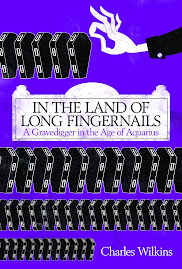
Charlie Wilkins adds, “…vivid and sultry and tumultuous…populated by a Mardi Gras of characters…in which the imagination is invited to get up and dance…”
What do murder, horses and Lila’s creole diner have in common? Head down to St. Tremaine Parish near New Orleans and find out. Meet Bryn Wiley, a mild equine writer, who discovers a show horse breeder facing financial ruin, foreclosure and far worse! Then the sheriff fingers a champion stallion as a killer…but Bryn believes otherwise! Wherever there are horses there are money, deception and powerful secrets. Can Bryn unmask the real murderer before the stallion gets a lethal injection? In the sultry Louisiana heat, she roams New Orleans seeking a slayer—in a desperate race to save the stallion. The story drips with sweat, Spanish moss, a voodoo queen, blooded horses and quirky Deep South characters. (great blurb, no?)
Charlie Wilkins adds, “…vivid and sultry and tumultuous…populated by a Mardi Gras of characters…in which the imagination is invited to get up and dance…”
Glenn Ponka's reading list
"Ilium" by Dan Simmons - this is an amazingly creative science fiction novel. The protagonist is a 20th century scholar of Homer's Illiad brought back to life in the far future, by the Greek gods living on Olympos Mons (the Texas-sized mountain on Mars). For the gods he has spent a decade secretly observing the battle between the Greeks and Trojans at Illium, covertly mingling with noble Hector and the man-killer Achillies. Well, he falls for Helen, and decides he can stop the war... And then there's two other major plotlines, one with babied post-literate humans on earth, and another about a small Shakespeare-loving robot and his friend, a two-ton, crab-like robot who is a Proust enthusiast. And they live around Jupiter. It might sound a little crazy, but it is impossible to sum up the novel in a few words, and that's good.
"Olympos" by Dan Simmons - this is the continuation of "Illium", and the madness continues on, fascinating and wonderfully interesting.
"Stardust" By Neil Gaiman - a fairy tale, new and wondrous. I haven't seen the film yet, but I hear it does a good job of adapting this lovely novel.
"A Short History of Nearly Everything" by Bill Bryson - this is a walk through science and history, it explains what we know of the universe, and tells us about the eccentric people who figured it all out. A great book to read and learn from.
"Olympos" by Dan Simmons - this is the continuation of "Illium", and the madness continues on, fascinating and wonderfully interesting.
"Stardust" By Neil Gaiman - a fairy tale, new and wondrous. I haven't seen the film yet, but I hear it does a good job of adapting this lovely novel.
"A Short History of Nearly Everything" by Bill Bryson - this is a walk through science and history, it explains what we know of the universe, and tells us about the eccentric people who figured it all out. A great book to read and learn from.
Thursday, December 6, 2007
THUNDER BAY'S GG WINNER
Big Congrats to Duncan Weller who won the Governor Gerneral's Award for his illustrated children's book The Boy From the Sun. Signings take place at Calicos on Bay Street this Saturday the 8th from 12 - 4, and at the Thunder Bay Art Gallery, with Jean Pendziwal, on Sunday the 9th from 12 - 4. He will also be at the CLE, the 16th of December.
GILLER PRIZE CONTEST
Win a copy of Late Nights on Air by Elizabeth Hay. This novel won this year's Giller Prize. To enter, send in the name of your favourite Canadian work of fiction (short story or novel) to joanbaril@gmail.com. Draw takes place December 20. Winner will be advised by e mail.
Wednesday, December 5, 2007
SOME GOOD-BYES
Good bye, Jane Rule. Your gentle, life-affirming novels will not be forgotten. An author of nine novels including The Young in One Another’s Arms and Desert of the Heart, your books reflected your personal generosity. You were the first Canadian female author to write about being gay as part of normal life. Jane died of liver cancer November 28, 2007 on Galiano Island. Her partner, Helen Sonthoff, predeceased her in 2000.
Good-bye Norval Morrisseau. Thunder Bay is culturally richer because of you. Your works are part of our psyche and we thank you for them. Norval died in Toronto General on December 4, 2007 after a long battle with Parkinson’s.
Good-bye Norval Morrisseau. Thunder Bay is culturally richer because of you. Your works are part of our psyche and we thank you for them. Norval died in Toronto General on December 4, 2007 after a long battle with Parkinson’s.
DETOUR by Gwen O'Reilly
Wandering, unfound
for once heedless of direction
and unconcerned
where these back roads lead
your head is full of maps
and for now,my uncharted heart is content
to let you steer.
if I grow uncertain,
you will reassure me
that without a destination
we cannot lose our way.
I will have to be content with that,
because with sun and stars obscured in
this unfamiliar land
I cannot set my own course
suspended in the trust of travel
one question will not quit me.
Have these bearings been aligned
only by the pull of North?
or was there a more subtle than
magnetic mystery
that drew us onward
for once heedless of direction
and unconcerned
where these back roads lead
your head is full of maps
and for now,my uncharted heart is content
to let you steer.
if I grow uncertain,
you will reassure me
that without a destination
we cannot lose our way.
I will have to be content with that,
because with sun and stars obscured in
this unfamiliar land
I cannot set my own course
suspended in the trust of travel
one question will not quit me.
Have these bearings been aligned
only by the pull of North?
or was there a more subtle than
magnetic mystery
that drew us onward
Subscribe to:
Posts (Atom)


















































.JPG)