One of Thunder Bay's favourite authors has a new book out. Called Dog Tracks, this is novel about those who return to the reserve. An uprooted gal called Abby finds home and herself and along the way, the reader glimpses traditional and non-traditional life in a Northern Ontario reserve.
About five years ago, when I was teaching Canadian Literature at Confederation College, Slipperjack's first novel, Honour the Sun, was on the curriculum. It was by far the students' favourite and beat out The English Patient, Alice Munro (Moons of Jupiter), Margaret Atwood (Handmaid's Tale), The Jade Peony (Wayson Choy).
Dog tracks is listed as a Young Adult novel and arrives at the Northern Women's Bookshop, 65 S. Court St. just in time for Christmas.
Friday, October 24, 2008


Thursday, October 23, 2008
One of Canada' funniest writers - a launch
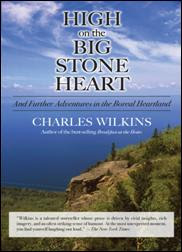
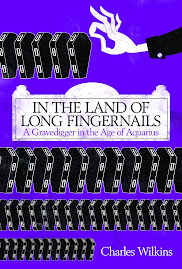
Charlie Wilkins is having his new book launch
Saturday, October 25 noon to 4
at the Finnish Book Store on Bay and Algoma.
Charlie will read at 1. p.m. and 2:30 p.m.
Here's a little summary of his book, which is a true story, based on his time working in a Toronto graveyard.
In the hazy summer of 1969, Charles Wilkins, then a university student,took a job as a gravedigger and roustabout in a huge Toronto cemetery.
The bizarre-but-true events of that time - including a midsummer gravediggers' strike, the unearthing of a victim of an unsolved murder, and a little illegal bone-shifting - play out amidst a Barnumesque parade of muckers and misfits in this macabre and hilarious memoir.
Wednesday, October 15, 2008
Sharon Irvine, Poet
You are invited to a poetry reading by
Sharon Irvine
At the Northern Woman’s Bookstore
65 Court Street South
On October the 23 at 7:30 P.M.
This is a free event and everyone is welcome
Come feed your soul …
For more information 344-3660
Sharon Irvine
At the Northern Woman’s Bookstore
65 Court Street South
On October the 23 at 7:30 P.M.
This is a free event and everyone is welcome
Come feed your soul …
For more information 344-3660
Monday, October 13, 2008
Confedearation College, a social history
Some time ago, Charlie Wilkins was commissioned to write a social history of the college. the result is a lively look at one of Thunder Bay's foremost places. Here is an excerpt from the introduction.
...voices telling their own stories. Or telling the stories of those who are no longer here to speak for themselves. Those of, say, Air Vice Marshall Bradshaw, a natty and utilitarian visionary, who having once directed the NATO Defence Command and built air bases across Europe -- and having been Commander of the Royal Military College -- was an obvious choice as the college’s first president. And of Bradshaw’s brilliantly eccentric properties manager, Ian Clark, a self-styled ecologist and conservationist who, during one phase of the construction of the main campus, tied ribbons onto trees close to the building site, with the contractual understanding that, if even one of those trees was damaged, there would be a ten-thousand-dollar penalty to the contractor.
It is the voices of Ram Ramanathan (an aeronautical engineer whose energy and persistence were a mainstay of the developing aviation program); of Dick O’Donnell and Ralph Scharf (ground breakers in distance education); and of Barry Caswell (whose pioneering work in Developmental Services marked the beginnings of computerised communication for those silenced by illness or profound handicaps). It is the voices of Claire Kaukinen and Diane Scott, who over the years applied their talents to programs as diverse as nursing, broadcasting and literacy and as widely based as the Canadian North and the back roads of China and Colombia. And Lynne Thornburg, whose mandate as an upstart in the mid-1970s, was to introduce both the college and community to a radical new perspective on the rights and roles of women.
And Tony Acker, a retired broadcasting professor, who advised me on sitting down to talk that of course his stories would be “useless in any sort of history,” because they were simply too scandalous. Which was all the more reason to include two or three of them.
It is the voices of former students such as Les Hanbury, J.P. Fraser and Linda Sargent. And of writer Linda Turk, whose lively essay, “My College Career,” reports on her life as a teen-aged freshman in secretarial science and then theatre during the early 1970s, and on faculty members such as guidance counselor, Jim Stevens (“the easiest man in the world to talk to”), and the inimitable broadcaster, Don Percy (whose advice to Linda was that she should never ever ask her hairdresser what time she should come for her appointment, but should just tell him what time she’d be there).
It is a story that began amid Sixties idealism and lavish government spending (a time of mini-skirts, Beatle hits and Expo 67... of OFY and LIP grants); that proceeded into computers, Free Trade, and government cutbacks (with their obliged creative survivalism); and emerged eventually into Glasnost and globalization... the story of a college that, in less than four decades, expanded its influence from a tiny office off May Street in Fort William to a tract of northern Ontario that the Air Vice Marshall enjoyed comparing to “a country the size of France” -- from the modest old McIntyre Building (with its unintended indoor “frog pond”) to the furthest corners of Asia and South America.
The story takes place in hospitals, carpentry shops, and film studios -- in the forests, in the air, and on remote Native reserves. It encompasses the social and shop practices of “the Dirty Dozen” (who once ran trade education in the Dorion Building); the music of Brahms and Beethoven (Hugh MacDonald’s Civilisation courses are said to have influenced some 2,000 students); and the courage of a grade-nine drop-out, who during her early thirties came to the college for academic upgrading and is now a practising pediatrician.
It encompasses President Bradshaw’s earliest dream of an aviation program for the North, and the college’s world-respected Aviation Centre of Excellence, which was introduced with fanfare in February, 2004. Encompasses the machine-dispensed “ratburgers” that were a mainstay of the pre-cafeteria Shuniah Building, and the refined cuisine that is a hallmark of the college’s present-day Hotel and Restaurant Management program.
From the point of view of Confederation’s Native students and advisors, it is the story of an early germ of an idea that perhaps one day the college might embody a self-directed program of Aboriginal education (Native language, Native politics, Native history) -- the story of the hard work and planning of the likes of Frank Maunula, Gerry Perrault and Brenda Small; and of the founding in 1999 of Negahneewin -- the college within the college -- one of the first and most successful of its kind.
It is the story of three strikes, four presidents, and nearly thirty thousand graduates... of world champion curlers, the founding of Nunavut, and generations of cats living wild beneath the Shuniah Building; the story of graduating grandmothers, global adventures, and intense internal debate.
We are perhaps wisely reminded that it is also the story of lapsed courses, periodically strained politics, and increasingly restrictive budgets -- in other words of the realities of institutional education in the late 20th and early 21st century.
Which makes it no less a story of imagination and purpose -- indeed makes it more such a story because of the ongoing requirement for innovative programs and fundraising. It is a story of longstanding commitment to a community.
On a personal level, it is a story that I am happy to be a part of, if only as a conduit for the voices of those who tell it. And so here they are -- as varied and forthright, and in many cases as expansive, as the landscape and people the college has served.
...voices telling their own stories. Or telling the stories of those who are no longer here to speak for themselves. Those of, say, Air Vice Marshall Bradshaw, a natty and utilitarian visionary, who having once directed the NATO Defence Command and built air bases across Europe -- and having been Commander of the Royal Military College -- was an obvious choice as the college’s first president. And of Bradshaw’s brilliantly eccentric properties manager, Ian Clark, a self-styled ecologist and conservationist who, during one phase of the construction of the main campus, tied ribbons onto trees close to the building site, with the contractual understanding that, if even one of those trees was damaged, there would be a ten-thousand-dollar penalty to the contractor.
It is the voices of Ram Ramanathan (an aeronautical engineer whose energy and persistence were a mainstay of the developing aviation program); of Dick O’Donnell and Ralph Scharf (ground breakers in distance education); and of Barry Caswell (whose pioneering work in Developmental Services marked the beginnings of computerised communication for those silenced by illness or profound handicaps). It is the voices of Claire Kaukinen and Diane Scott, who over the years applied their talents to programs as diverse as nursing, broadcasting and literacy and as widely based as the Canadian North and the back roads of China and Colombia. And Lynne Thornburg, whose mandate as an upstart in the mid-1970s, was to introduce both the college and community to a radical new perspective on the rights and roles of women.
And Tony Acker, a retired broadcasting professor, who advised me on sitting down to talk that of course his stories would be “useless in any sort of history,” because they were simply too scandalous. Which was all the more reason to include two or three of them.
It is the voices of former students such as Les Hanbury, J.P. Fraser and Linda Sargent. And of writer Linda Turk, whose lively essay, “My College Career,” reports on her life as a teen-aged freshman in secretarial science and then theatre during the early 1970s, and on faculty members such as guidance counselor, Jim Stevens (“the easiest man in the world to talk to”), and the inimitable broadcaster, Don Percy (whose advice to Linda was that she should never ever ask her hairdresser what time she should come for her appointment, but should just tell him what time she’d be there).
It is a story that began amid Sixties idealism and lavish government spending (a time of mini-skirts, Beatle hits and Expo 67... of OFY and LIP grants); that proceeded into computers, Free Trade, and government cutbacks (with their obliged creative survivalism); and emerged eventually into Glasnost and globalization... the story of a college that, in less than four decades, expanded its influence from a tiny office off May Street in Fort William to a tract of northern Ontario that the Air Vice Marshall enjoyed comparing to “a country the size of France” -- from the modest old McIntyre Building (with its unintended indoor “frog pond”) to the furthest corners of Asia and South America.
The story takes place in hospitals, carpentry shops, and film studios -- in the forests, in the air, and on remote Native reserves. It encompasses the social and shop practices of “the Dirty Dozen” (who once ran trade education in the Dorion Building); the music of Brahms and Beethoven (Hugh MacDonald’s Civilisation courses are said to have influenced some 2,000 students); and the courage of a grade-nine drop-out, who during her early thirties came to the college for academic upgrading and is now a practising pediatrician.
It encompasses President Bradshaw’s earliest dream of an aviation program for the North, and the college’s world-respected Aviation Centre of Excellence, which was introduced with fanfare in February, 2004. Encompasses the machine-dispensed “ratburgers” that were a mainstay of the pre-cafeteria Shuniah Building, and the refined cuisine that is a hallmark of the college’s present-day Hotel and Restaurant Management program.
From the point of view of Confederation’s Native students and advisors, it is the story of an early germ of an idea that perhaps one day the college might embody a self-directed program of Aboriginal education (Native language, Native politics, Native history) -- the story of the hard work and planning of the likes of Frank Maunula, Gerry Perrault and Brenda Small; and of the founding in 1999 of Negahneewin -- the college within the college -- one of the first and most successful of its kind.
It is the story of three strikes, four presidents, and nearly thirty thousand graduates... of world champion curlers, the founding of Nunavut, and generations of cats living wild beneath the Shuniah Building; the story of graduating grandmothers, global adventures, and intense internal debate.
We are perhaps wisely reminded that it is also the story of lapsed courses, periodically strained politics, and increasingly restrictive budgets -- in other words of the realities of institutional education in the late 20th and early 21st century.
Which makes it no less a story of imagination and purpose -- indeed makes it more such a story because of the ongoing requirement for innovative programs and fundraising. It is a story of longstanding commitment to a community.
On a personal level, it is a story that I am happy to be a part of, if only as a conduit for the voices of those who tell it. And so here they are -- as varied and forthright, and in many cases as expansive, as the landscape and people the college has served.
Sunday, October 12, 2008
Prize winning poetry by Sue Blott
Lovers’ Lane
I’ve nicknamed my walking path
Lovers’ Lane this spring.
A messy crow’s nest
perches on a hydro tower
and two crows teeter
on spruce tree tops
like charred stars.
They flap black wings
and caw caw a warning
as the dog and I stroll by.
Between railways tracks,
a pair of Canada geese
crane ringed necks
to watch us pass.
Further along another pair,
less brave,
waddle over steel tracks
and down an embankment
as they scold us
with their honking.
In a driveway
on an intersecting street,
a red-clad toddler
be-bops to the road.
Behind, her parents cluck,
“Come here. Stay close!”
All the birds quiet
and still themselves
to listen.
What Else?
On the back steps, my black dog lies,
fur drenched by the rising sun.
With his eyes closed, his nose twitches
sensing seasons change.
What else to do, this August morn,
but sit beside him sipping tea?
A Mingling Moment
As Emily Brontë walked Yorkshire Moors
with her mastiff, Keeper,
braving fierce northern gales,
which must have ripped through
all her best woollen clothes
to ravage her innermost folds,
so I walk on cracked-egg tarmac
with my black mongrel, Rascal,
down to the Kaministiquia River,
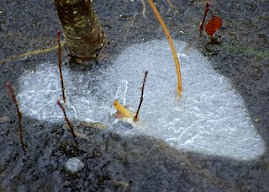
frozen with whorls like heart prints,
beyond which Mount MacKay looms
and beckons with native mysticism.
A rattle of bridge iron
and a drone of transports
combines with a moan from ice floes;
I imagine it is Emily’s skeleton creaking
while her spirit emits a restless groan.
A poem comes whistling on the wind.
“Here, Keeper!” I call and,
in a mingling moment,
see a purple span of heather,
hear sheep bleating
and feel the yearning of a poet’s soul
by a river in northern Ontario.
I’ve nicknamed my walking path
Lovers’ Lane this spring.
A messy crow’s nest
perches on a hydro tower
and two crows teeter
on spruce tree tops
like charred stars.
They flap black wings
and caw caw a warning
as the dog and I stroll by.
Between railways tracks,
a pair of Canada geese
crane ringed necks
to watch us pass.
Further along another pair,
less brave,
waddle over steel tracks
and down an embankment
as they scold us
with their honking.
In a driveway
on an intersecting street,
a red-clad toddler
be-bops to the road.
Behind, her parents cluck,
“Come here. Stay close!”
All the birds quiet
and still themselves
to listen.
What Else?
On the back steps, my black dog lies,
fur drenched by the rising sun.
With his eyes closed, his nose twitches
sensing seasons change.
What else to do, this August morn,
but sit beside him sipping tea?
A Mingling Moment
As Emily Brontë walked Yorkshire Moors
with her mastiff, Keeper,
braving fierce northern gales,
which must have ripped through
all her best woollen clothes
to ravage her innermost folds,
so I walk on cracked-egg tarmac
with my black mongrel, Rascal,
down to the Kaministiquia River,
frozen with whorls like heart prints,
beyond which Mount MacKay looms
and beckons with native mysticism.
A rattle of bridge iron
and a drone of transports
combines with a moan from ice floes;
I imagine it is Emily’s skeleton creaking
while her spirit emits a restless groan.
A poem comes whistling on the wind.
“Here, Keeper!” I call and,
in a mingling moment,
see a purple span of heather,
hear sheep bleating
and feel the yearning of a poet’s soul
by a river in northern Ontario.
Subscribe to:
Posts (Atom)








































.JPG)